The Foundational Learning Assistance program has existed in Alberta for decades. For most of that time, it was a stable, predictable source of support for ESL and Academic Upgrading students. In recent years, that stability has changed significantly.
Understanding what has happened to the FLA budget — and what it means for you as a NAIT student today — is not just background information. It directly affects your chances of getting funded and what you should do about it.
What Changed — The Federal Funding Cut
The origins of the current FLA budget pressure go back to 2017, when the federal government introduced a top-up to the Labour Market Transfer Agreement (LMTA) — a funding mechanism that transfers money from the federal government to provinces for employment and training programs.
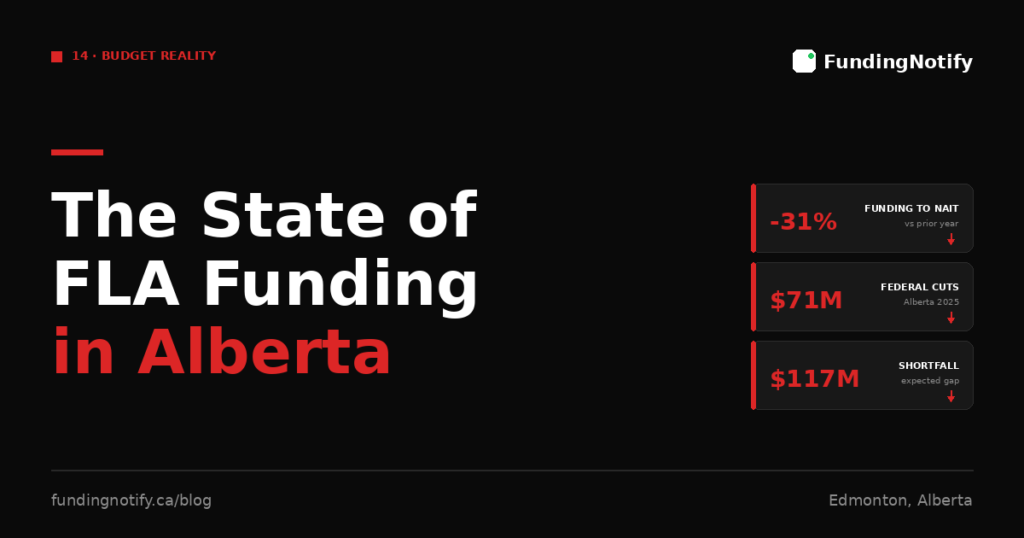
That top-up, which had been flowing to Alberta and other provinces for years, ended in the summer of 2024. The result for Alberta was a reduction of nearly $71 million in provincial funding for employment and training programs. About half of that — approximately $34.7 million — affected the advanced education budget, including FLA directly.
Alberta’s Advanced Education Minister described being “blindsided” by the cut, though the federal government noted that provinces had been informed since 2017 that the top-up would end.
The Direct Impact on NAIT
The consequences at NAIT were concrete and immediate.
NAIT’s vice-president academic confirmed that the institution’s FLA funding allocation was 31 percent lower than the previous year. The number of students enrolled in English language learning and Academic Upgrading at NAIT halved as a result.
For context: more than 40 organizations across Alberta — including 14 post-secondary institutions — had planned their programs expecting nearly $117 million in FLA funding for that school year. They received significantly less.
NAIT is not alone. NorQuest College in Edmonton received 24 percent less funding and was still calculating how many FLA-funded students would enroll for the following term. Institutions across the province were forced to halt or drastically limit new FLA applications.
What This Means for the Competition
The math is straightforward and important:
- Fewer dollars available per session
- Same number (or more) of eligible students
- Same first-come, first-served distribution system
The result is a funding window that is more competitive than ever. In sessions before the cuts, the window might stay effectively open for several hours before funds were exhausted. With a reduced budget and the same demand, the window closes faster.
The 6-hour average for all available spots to be claimed is not a fixed number — it reflects conditions where the budget is already under pressure. In sessions where the provincial allocation is particularly constrained, that window can be even shorter.
Alberta Budget 2026 — Some Signals
Alberta’s Budget 2026, released in February 2026, included $20 million to support multicultural and newcomer supports and anti-racism initiatives to help Albertans from diverse backgrounds achieve their full potential. It also included workforce and economic immigration investments.
However, specific line items for the FLA program were not publicly detailed in the budget highlights available. The Government of Alberta is reviewing the FLA program, and the minister has indicated that post-secondary institutions should “expect change.”
What this means in practice: the FLA program continues to operate, funding continues to flow each term, and students continue to be funded through the first-come, first-served process. But the budget environment remains uncertain and the competition for each session’s available funds remains intense.
The Advocate Position — Why Critics Say This Matters
The Alberta NDP’s advanced education critic described the government’s refusal to restore FLA funding as budgeted as “deeply irresponsible.” His argument was direct:
The provincial government actively recruited newcomers to Alberta. Those newcomers need ESL and Academic Upgrading programs to improve their English, qualify for better jobs, and contribute to the provincial economy. Without FLA funding, many of them cannot afford these programs.
The Edmonton-based Project Adult Literacy Society (PALS), which provides free adult literacy and ESL support but does not receive FLA funding, saw its waiting list grow to over 100 people as a direct result of FLA funding cuts pushing students to find alternatives.
As PALS executive director Monica Das described it, the impact of adult literacy and language programs reaches far beyond individual students — it addresses food insecurity, unemployment, and breaks cycles of low literacy within families.
What This Means for You Practically
If you are a NAIT ESL or Academic Upgrading student in 2026, the budget context translates into three practical realities:
1. The competition for FLA funding is at its most intense in years. Fewer dollars, same demand. Every eligible student is competing for a smaller pool of money. Speed matters more than it ever has.
2. The program still exists and funding still flows. Despite the cuts and uncertainty, the FLA program is active. NAIT continues to register students, invitation emails continue to go out, and students continue to be funded each session. The question is not whether the money exists — it is whether you will be among the students who access it.
3. The window is not going to get wider. There is no indication that the federal top-up will be restored, and the provincial review has not announced increased FLA allocations. The competitive, first-come, first-served dynamic is the baseline going forward — and the practical window for each session is likely to remain short.
The Honest Assessment
The FLA program remains one of the most valuable financial support tools available to NAIT ESL and Academic Upgrading students. It covers tuition, books, and a monthly living allowance — without requiring repayment.
But the budget environment has made what was already a competitive process even more competitive. Students who prepared for a forgiving system — where checking email once a day was sufficient — are now entering a system where the window can close in hours.
The students who understand this and prepare accordingly will continue to access the funding. The students who do not will continue to miss it, not because they are ineligible, but because the system was not designed with them in mind.
The One Thing That Changes Your Position
Given the budget reality, the single most impactful thing you can do as a NAIT ESL student is to make sure you are among the first to know when the funding window opens.
FundingNotify calls your phone the moment the NAIT funding email arrives. Not an email notification. A phone call — followed by an SMS with the direct application link. If you do not answer, a second call fires 5 minutes later.
In a funding window where the competitive period is 6 hours or less, the difference between receiving a phone call in the first minute and checking your email 3 hours later is often the difference between getting funded and not.
The setup takes 2 minutes and is done once:
- Sign up at fundingnotify.ca
- Forward emails from
@nait.catomonitoring@fundingnotify.ca
Every session after that — Fall, Winter, Spring — your phone will ring when the window opens.
👉 Activate your alert at fundingnotify.ca
FundingNotify is not affiliated with NAIT or the Government of Alberta. It is an independent service designed and operated in Edmonton, Alberta.
Sources: CBC News Edmonton — January 2025 and August 2024 · Government of Alberta — Budget 2026 highlights · alberta.ca/foundational-learning-assistance · NAIT Continuing Education — nait.ca · FundingNotify — fundingnotify.ca. Last updated: May 2026.
Ne manque plus jamais ton funding NAIT Never miss your NAIT funding again
SMS + appel automatique dès l'ouverture du funding. 30 $ pour toute la session. SMS + automatic call when funding opens. $30 for the entire session.
Activer mon alerte — 30 $ Activate my alert — $30Articles similaires Related articles
If you did not finish high school, or if your high school grades are not strong enough to enter the NAIT program you want, Academic…
The numbers around NAIT’s FLA funding — 48 hours, 6 hours, 3 sessions per year — are easy to read but hard to feel. What…
If you are a NAIT ESL or Academic Upgrading student waiting for FLA funding, FundingNotify exists to solve one specific problem: you need to know…